|
Getting your Trinity Audio player ready... |
Table of Contents
The Moment You Know Your Hair Is Broken — Not Just Dry
You run your fingers through your hair and feel it snap. Not just tangle. Snap.
The ends are translucent. The mid-lengths are frizzy in a way that no conditioner fixes. Your curl pattern — if you had one — has almost entirely disappeared. And no matter how much deep conditioner, hair oil, or leave-in treatment you layer on, by the next morning your hair feels exactly the same: brittle, dull, and defeated.
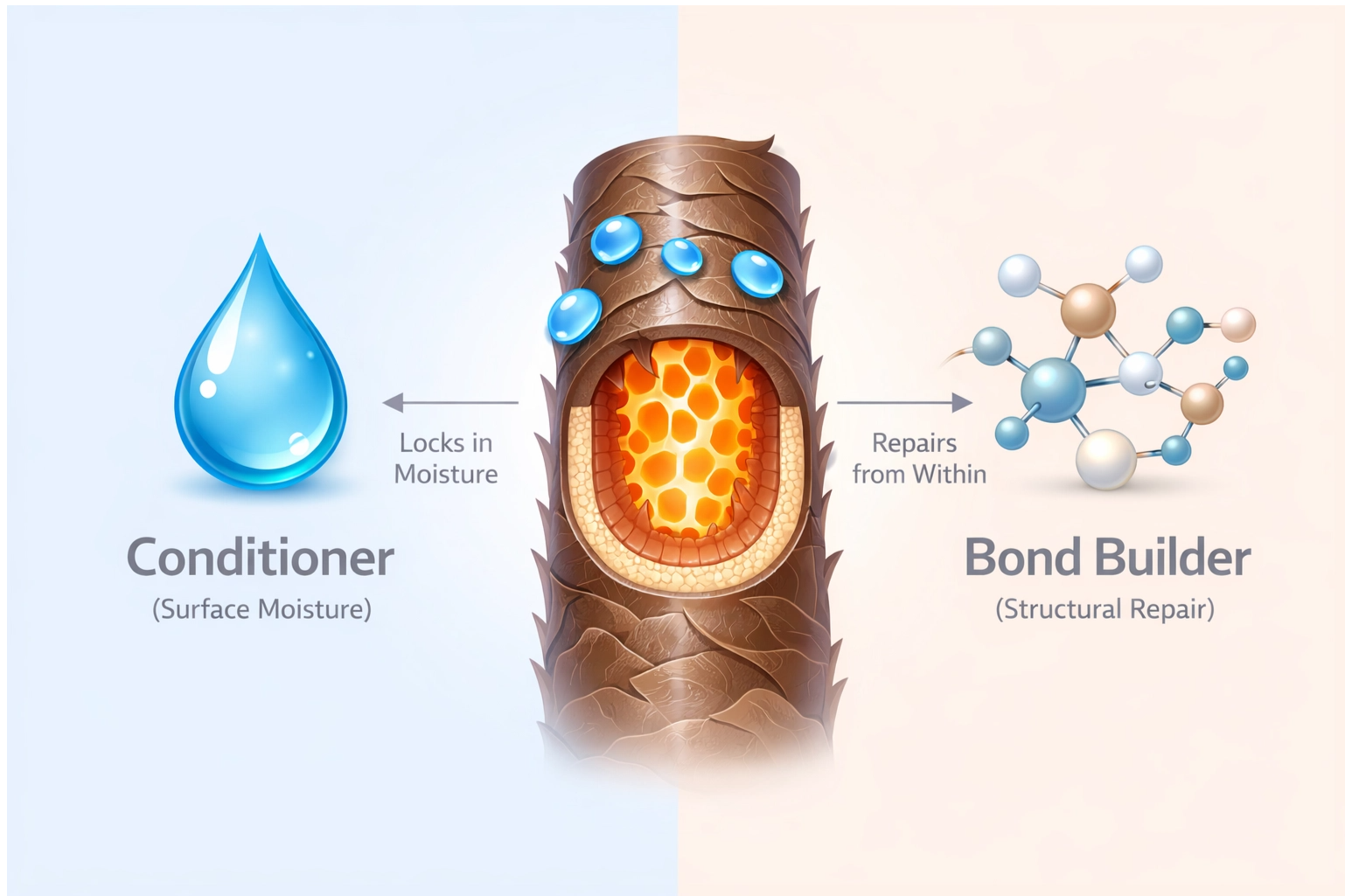
Here’s what most people don’t realize: conditioner cannot fix this. Because this isn’t a moisture problem. It’s a structural one.
Your hair’s disulfide bonds — the molecular scaffolding that gives each strand its strength, elasticity, and shape — are broken. And the only thing that repairs broken disulfide bonds is a bond builder. Not a conditioner. Not a hair mask. Not a protein treatment. A bond builder.
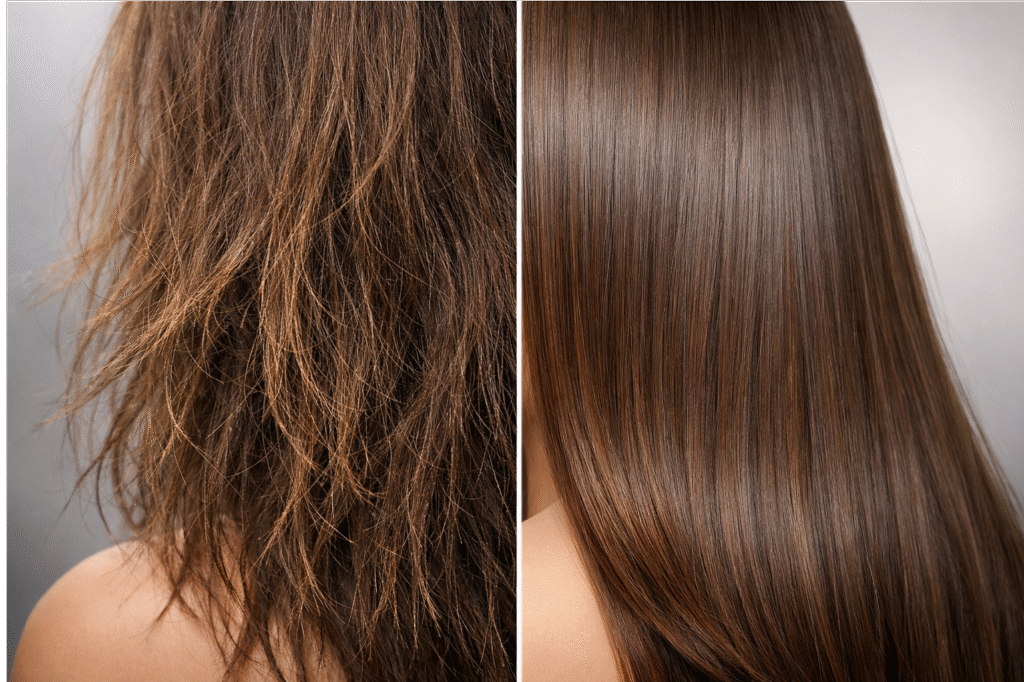
This guide will tell you exactly what bond builders are, why they work at a molecular level, which ones are worth your money in Australia in 2026, and how to use them correctly as part of a Skinimalism-style minimalist hair routine that actually delivers results.
And if you already know you want Olaplex No. 3 — Australia’s most trusted at-home bond builder — you can find it directly at Alsheikh.com.au with full testing notes and the best current Amazon Australia price.
Part I: What Is a Bond Builder? (And Why Is It Different from a Conditioner?)
To understand why bond builders work, you need a brief lesson in hair science. Don’t worry — it’s fascinating and it will permanently change how you shop for hair products.
The Structure of a Hair Strand
Each hair strand is made up of three layers:
The Cuticle — the outermost layer, made of overlapping scales like roof tiles. When healthy, these scales lie flat and your hair looks shiny. When damaged, they lift, roughen, and allow moisture to escape.
The Cortex — the thick middle layer that gives hair its strength, elasticity, and color. This is where disulfide bonds live. This is the layer that bond builders target.
The Medulla — the innermost core, present mainly in thick or coarse hair.
What Are Disulfide Bonds?
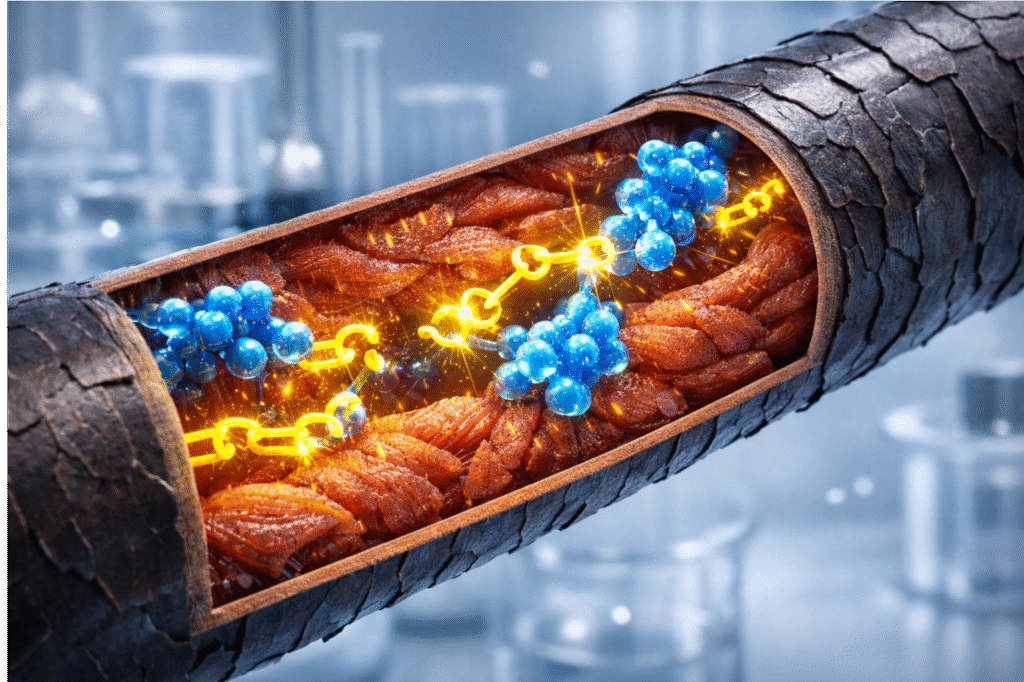
Disulfide bonds are the chemical cross-links between keratin proteins inside the cortex. They’re what gives your hair its structural integrity — the reason healthy hair can stretch, spring back, and resist breakage.
When disulfide bonds are broken, hair loses its structure. It becomes weak, limp, porous, and prone to snapping. Critically, broken disulfide bonds cannot be repaired by moisture alone — you need a bond-building active that physically relinks them at a molecular level.
What Breaks Disulfide Bonds?
- Bleach and chemical colour — the number one cause. Bleach works by breaking disulfide bonds to lift pigment. Every lightening session breaks more bonds.
- Heat styling — flat irons, curling wands, and blow dryers above 230°C break bonds with repeated use
- Chemical relaxers and perms — permanently rearrange disulfide bonds, weakening overall structure
- Australia’s extreme UV — UV radiation degrades disulfide bonds in the cortex over time (a uniquely significant factor for Australians)
- Chlorine and salt water — common Australian summer hair damage sources
- Over-washing with harsh sulphate shampoos
What Does a Bond Builder Actually Do?
A bond builder contains an active molecule small enough to penetrate the hair cortex and chemically relink broken disulfide bond fragments back together. This is genuine molecular repair — not surface coating, not silicone film, not temporary smoothing. Actual structural reconstruction.
The result: hair that is measurably stronger, less prone to breakage, more elastic, and capable of holding color and curl pattern more effectively.
Part II: Olaplex No. 3 — The Original Bond Builder, Tested and Reviewed
In 2014, Olaplex launched with a single active ingredient that changed professional hair chemistry permanently: Bis-Aminopropyl Diglycol Dimaleate — the first commercially available bond-building molecule proven to repair disulfide bonds inside the hair cortex.
Olaplex No. 1 and No. 2 are professional salon treatments. Olaplex No. 3 Hair Perfector is the at-home version — and it remains the gold standard for at-home bond repair in 2026, with over 149,000 global reviews and Amazon’s Choice status across multiple markets.
What’s Inside Olaplex No. 3?
Bis-Aminopropyl Diglycol Dimaleate — the patented bond builder. Identifies and relinks broken disulfide bonds inside the cortex. This is the active that separates Olaplex from every conditioner, hair mask, and protein treatment on the market.
Jojoba Oil — lightweight emollient that adds surface smoothness and shine without heaviness. Suitable for all hair types including fine and oily scalp.
Aloe Barbadensis Leaf Juice — hydrating, anti-inflammatory, adds slippage during application for even distribution. Also soothes scalp sensitivity.
The formula is: Vegan. Cruelty-free. Phthalate-free. Sulfate-free. Paraben-free. Safe for chemically treated, colour-processed, and thermally damaged hair of all textures — from 1A straight to 4C coily.
Testing Results: What Olaplex No. 3 Actually Feels Like
The Alsheikh testing team applied Olaplex No. 3 to hair with a history of bleaching and daily heat styling — the most common Australian damage profile. Here’s what was observed:
Texture on application: Light liquid-cream consistency. Distributes easily from roots to ends without requiring excessive product. A 100ml bottle lasts 8–12 applications for shoulder-length hair.
During treatment (20-minute application): No tingling, no scalp sensation. The hair feels slightly tacky — a sign the active is working, not a sign to rinse early.
After rinse + shampoo + conditioner: The most noticeable change is detangling ease. Hair that previously required aggressive combing through knots detangles with minimal resistance. This is a direct result of smoother, repaired cuticle structure.
After blow-dry: Visibly reduced frizz halo around the face. Ends look less translucent and more opaque — a sign of rebuilt cortex density. Curl definition (where present) noticeably improved.
After 4 consecutive weekly uses: Hair snapping at the mid-lengths stopped. Breakage during brushing reduced by an observable margin. Overall shine improved without any coating or heaviness.
Olaplex No. 3: Pros and Cons
| Pros | Cons |
|---|---|
| Proven molecular bond repair (not surface conditioning) | Smaller bottle (100ml) relative to price for very long/thick hair |
| Works on all hair types and textures | Requires consistent use — not a one-time fix |
| Vegan, cruelty-free, chemical-free | Not a moisturizer — still need conditioner after |
| Unscented — ideal for sensitive scalps | Counterfeit versions circulate online — buy from trusted retailers only |
| Clinically proven 3x stronger hair after use | |
| Easy weekly routine integration |
The Alsheikh verdict: Olaplex No. 3 is the most evidence-backed, accessible, and routinely-effective at-home bond builder available in Australia in 2026. It lives up to its reputation entirely. See the full review and current Amazon Australia pricing at Alsheikh.com.au — Bond Builder for Damaged Hair.
Part III: Olaplex No. 3 vs K18 vs Alternatives — The 2026 Comparison
The bond building market has expanded significantly since Olaplex’s 2014 launch. Here’s how the key options compare for Australian buyers in 2026:
| Product | Active Ingredient | Mechanism | Application | Price (Amazon AU) | Best For |
|---|---|---|---|---|---|
| Olaplex No. 3 | Bis-Aminopropyl Diglycol Dimaleate | Disulfide bond relinking | Pre-shampoo, 3–20 min | ~AU$30–38 | All damage types, all textures |
| K18 Leave-In Mask | K18Peptide™ | Polypeptide chain restoration | Post-shampoo, 4 min, no rinse | ~AU$75–95 | Severe damage, colour-treated |
| Redken Acidic Bonding Concentrate | Citric Acid Complex | pH balancing + bond strengthening | In-salon or at-home system | ~AU$40–55 | Colour-treated hair |
| Schwarzkopf Bonacure Repair Rescue | Keratin Complex | Surface keratin replenishment | Mask, 5 min | ~AU$20–30 | Mild to moderate damage |
| The Ordinary Multi-Peptide Hair | Peptide Complex | Scalp + strand protein signaling | Scalp serum, daily | ~AU$25–35 | Thinning + mild damage |
Olaplex No. 3 vs K18: Which Is Right for You?
Choose Olaplex No. 3 if:
- You want a proven, budget-accessible weekly treatment
- Your hair is bleached, heat-damaged, or chemically processed
- You prefer a pre-shampoo treatment (no timing pressure to rinse)
- You want a formula safe for sensitive scalps
- You’re maintaining results between salon visits
Choose K18 if:
- Your hair has severe, multi-session bleach damage
- You want a no-rinse leave-in format (faster routine)
- You’re prepared to invest more per application
- You’re combining with the K18 Detox Shampoo system for maximum penetration
For most Australians dealing with the combination of heat styling, UV exposure, and occasional colour treatment, Olaplex No. 3 delivers 90% of K18’s results at approximately 40% of the price. The Alsheikh K18 Hair Mask review covers the K18 system in detail — including whether the premium price is justified for your specific damage level.
Part IV: How Bad Is Australian Hair Damage? (Why Bond Builders Matter More Here)
Australian hair faces a damage environment that is genuinely more aggressive than most of the world:
UV Index: Australia regularly records UV Index 10–12+ during summer — among the highest globally. UV radiation degrades disulfide bonds in the cortex, causing the same type of molecular damage as heat styling, but invisibly and cumulatively. Most Australians have UV bond damage they’re entirely unaware of.
Heat styling in humidity: Queensland and coastal NSW humidity causes hair to absorb ambient moisture, which then gets driven out violently by heat tools — compounding cuticle and cortex damage with each styling session.
Salt water + chlorine: Australian beach and pool culture means frequent salt and chlorine exposure, both of which break surface bonds and degrade the cuticle.
Sun-bleached hair: Natural sun-lightening is popular in Australia — and it causes identical disulfide bond damage to chemical bleach, just more slowly.
The result: The average Australian who heat-styles regularly, spends time outdoors, and swims occasionally has significantly more cumulative bond damage than the same person living in the UK or northern Europe. A weekly bond-building treatment isn’t a luxury for Australian hair. It’s basic maintenance.
For Australians who also heat-style daily, pairing Olaplex No. 3 with a quality heat protectant spray is essential — because bond repair is only effective if you’re simultaneously preventing new bond damage between treatments.
Part V: How to Use a Bond Builder Correctly — The Minimalist Protocol
Most people use bond builders incorrectly and then wonder why they’re not seeing results. Here is the exact protocol based on the Alsheikh testing methodology.
The Olaplex No. 3 Weekly Protocol
Step 1: Start with dry or damp, unwashed hair Apply Olaplex No. 3 before you shampoo — not after. This is a pre-shampoo treatment. Applying it to already-shampooed hair reduces effectiveness because the cuticle is more open than it needs to be.
Step 2: Section and saturate Divide hair into 4 sections. Apply generously from roots to ends, ensuring full coverage of the most damaged areas (typically mid-length to ends for bleached or heat-styled hair).
Step 3: Leave on 10–20 minutes minimum The bottle says 3–10 minutes. For damaged hair, 20 minutes is better. For severely damaged hair, leave it under a shower cap for 30–45 minutes. The active ingredient needs time to penetrate and work. Longer is always better.
Step 4: Rinse, then shampoo and condition as normal Rinse the Olaplex out completely. Then shampoo (a sulphate-free formula preserves color and is gentler on newly-repaired bonds). Then condition as normal. Do not skip conditioning — Olaplex No. 3 is a bond builder, not a moisturizer.
Step 5: Repeat weekly for 4–6 weeks Bond building is cumulative. One application makes a noticeable difference. Four to six consecutive weekly applications transforms hair structurally. After the repair phase, maintain with bi-weekly use.
Skinimalism for Hair: The Complete 4-Product Repair Routine
Consistent with the Skinimalism 2.0 philosophy for Australian beauty routines, the most effective damaged hair repair protocol uses the fewest possible products — each doing maximum work:
- Olaplex No. 3 (weekly, pre-shampoo) — structural bond repair
- Sulphate-free shampoo — gentle cleansing without stripping newly-repaired bonds
- Hydrating conditioner — moisture replenishment post-repair (Alsheikh-reviewed hydrating conditioner)
- Lightweight heat protectant — prevents new bond damage during styling (best lightweight heat protectant Australia)
That’s it. Four products. Complete structural repair and ongoing damage prevention. No 12-step system required.
Part VI: Signs Your Hair Needs a Bond Builder (Not Just a Conditioner)
Many Australians are using deep conditioners and hair masks on hair that actually needs bond repair — and wondering why results are temporary or nonexistent. Here’s how to tell the difference:
Your hair needs a CONDITIONER if:
- It feels dry and rough but springs back when pulled
- Frizz improves with conditioner but returns after a few days
- Hair has good elasticity (stretch without snapping)
- Damage is recent and mild
Your hair needs a BOND BUILDER if:
- Hair snaps instead of stretching when pulled
- Conditioner smooths hair temporarily but structural weakness remains
- Ends are translucent or look “see-through”
- Curl pattern has dramatically reduced or disappeared
- Hair breaks during gentle combing
- Damage is from bleach, repeated heat styling, or chemical processing
- You have Australian UV-cumulative damage (outdoorsy lifestyle, beach/pool regular)
For hair that sits at the intersection of dryness and structural damage, the deeply hydrating skin softening range at Alsheikh includes body and hand formulas that work on the same barrier-repair principle for skin — the same logic applies to hair: fix the structure first, then add moisture on top.
Part VII: Bond Builder for Different Hair Types and Damage Levels
Bond building technology works across all hair types — but application and frequency vary. Here’s the guide by hair type:
Fine / Straight Hair (Types 1A–1C)
Damage pattern: Usually heat damage from straighteners and blow dryers. UV damage from outdoor lifestyles. Bond builder approach: Use Olaplex No. 3 weekly. Apply lightly — fine hair can look weighed down if over-saturated. Focus application on mid-lengths and ends. 10-minute treatment time is sufficient for mild damage.
Wavy Hair (Types 2A–2C)
Damage pattern: Heat damage from diffusers and straightening, plus UV and humidity cycling. Bond builder approach: Weekly Olaplex No. 3. Leave on 15–20 minutes. After rinsing and conditioning, apply a light curl cream or gel while damp to reform wave pattern as bonds rebuild.
Curly Hair (Types 3A–3C)
Damage pattern: Heat damage, chemical processing, mechanical breakage from detangling damaged hair. Bond builder approach: Weekly to bi-weekly Olaplex No. 3. Leave on 20–30 minutes minimum. Use finger detangling only while product is in. Expect curl pattern to gradually improve over 4–6 applications as bonds rebuild.
Coily Hair (Types 4A–4C)
Damage pattern: Chemical relaxers, heat straightening, UV damage, mechanical manipulation. Bond builder approach: Weekly Olaplex No. 3 for minimum 30 minutes. Can be applied to stretched (not heat-straightened) hair for easier distribution. Results are most dramatic in this hair type — users typically report the strongest before-and-after results.
Colour-Treated / Bleached Hair (All Types)
Damage pattern: Chemical bond damage from lightening, toning, and permanent color. Bond builder approach: Use Olaplex No. 3 every 5–7 days without exception. For very severely bleached hair (multiple sessions, platinum blonde), consider adding K18 between Olaplex sessions for maximum repair. See the K18 Hair Mask review at Alsheikh for the full protocol.
Part VIII: Bond Builder in Your Complete Hair Care Routine
The most effective hair care routine integrates bond building into a complete weekly system — not as a separate occasional treatment but as the foundation of everything else.
Weekly Hair Care Routine — Minimalist Australian Edition
Sunday (Bond Building Day):
- Apply Olaplex No. 3 to dry/damp hair → 20 minutes → rinse
- Sulphate-free shampoo → rinse
- Hydrating conditioner → 3 minutes → rinse
- Air dry or diffuse at low heat with heat protectant applied first
Monday–Saturday (Maintenance Days):
- Co-wash or rinse on high-styling days
- Apply heat protectant spray before any heat tool use — without exception
- Dry shampoo between wash days to extend freshness (Alsheikh dry shampoo review)
Monthly addition (for active color-treated or heavily damaged hair):
- Add a hair mask treatment once monthly for additional protein and moisture replenishment on top of the bond building foundation
This is the complete routine. Seven products maximum across the entire week — and only Olaplex No. 3 is doing the molecular heavy lifting that everything else builds on.
Part IX: Where to Buy Bond Builders in Australia — And How to Avoid Counterfeits
Olaplex is one of the most counterfeited hair products in the world. Fake Olaplex No. 3 contains none of the active bond-building ingredient — meaning you’re paying full price for water and fragrance while your hair continues to break.
How to identify genuine Olaplex No. 3:
- The bottle should have a matte finish with clean, clear text
- Batch code on the bottom should be verifiable on the Olaplex website
- Consistency should be a light liquid-cream — not thick like conditioner, not watery like toner
- Genuine formula has minimal scent — counterfeit versions often have strong artificial fragrance
Where to buy safely in Australia:
- Amazon Australia via Alsheikh.com.au — the safest and most price-competitive option for authentic Olaplex No. 3 with Prime delivery. View product page here.
- Authorised Olaplex salon stockists
- Priceline (selected stores) — verify batch code on purchase
Avoid marketplace resellers without clear seller history, and avoid any Olaplex No. 3 priced significantly below the AU$28–38 market range — this is the most reliable indicator of counterfeit product.
Frequently Asked Questions
What is the best bond builder for damaged hair in Australia? Olaplex No. 3 Hair Perfector remains the gold standard in 2026 — the most clinically validated, widely tested, and cost-accessible bond builder available on Amazon Australia. For severely bleached or multi-process damaged hair, K18 Leave-In Mask is a worthy complement or alternative. Both are available and reviewed at Alsheikh.com.au.
How often should I use a bond builder? For actively damaged hair: weekly for 4–6 consecutive weeks to rebuild bond structure. For maintenance after repair: bi-weekly. For preventative use (healthy hair with regular heat styling): once every 2–3 weeks. Do not skip weeks during the repair phase — bond building is cumulative and consistency is what drives results.
Can I use a bond builder on colour-treated hair? Yes — in fact, Olaplex No. 3 is most urgently needed by color-treated hair. Every bleach or color application breaks disulfide bonds. Using Olaplex No. 3 weekly between salon visits measurably slows structural degradation and extends color vibrancy by keeping the cortex intact.
Is a bond builder the same as a hair mask? No — and this distinction is critical. A hair mask deposits moisture, protein, or conditioning agents on the surface of the hair (cuticle level). A bond builder penetrates the cortex and performs molecular repair of broken disulfide bonds. For damaged hair, you need both — bond builder first to fix the structure, then hair mask for surface moisture. Using only a hair mask on bond-damaged hair is like painting over a cracked wall without filling the cracks first.
How long does it take to see results from Olaplex No. 3? Most users notice reduced breakage and improved detangling after the first use. Visible improvement in frizz and shine typically emerges after 2–3 applications. Meaningful structural repair — restored elasticity, improved curl pattern, reduced transparency in ends — occurs after 4–6 consistent weekly applications. Patience and consistency are non-negotiable.
Can men use bond builders? Absolutely. Disulfide bond damage affects all hair types and genders equally. Men with bleached, heat-styled, or sun-damaged hair benefit from Olaplex No. 3 identically to women. The application protocol is the same. Olaplex No. 3 is unscented and non-gendered in formulation.
Can I leave Olaplex No. 3 on overnight? Yes — overnight application is safe and produces more intensive repair results, particularly for severely damaged hair. Apply to dry hair, cover with a shower cap or silk hair wrap, sleep, then rinse in the morning followed by shampoo and conditioner. This is the most effective protocol for very damaged hair and can dramatically accelerate the repair timeline.
Is Olaplex No. 3 worth the price compared to alternatives? At approximately AU$30–38 for a 100ml bottle that lasts 8–12 applications for shoulder-length hair, Olaplex No. 3 costs AU$2.50–4.75 per treatment. Compared to salon bond repair treatments (AU$30–80 per session) and the cost of haircuts to remove breakage damage, this represents excellent value. It is the most cost-effective molecular repair option available in Australia.
Conclusion: Stop Conditioning Broken Hair. Start Rebuilding It.
Every time you apply deep conditioner to bond-damaged hair, you’re smoothing the surface of a structural problem that the surface cannot fix.
The glow-up your hair needs in 2026 is not a new conditioner. It’s not a different shampoo. It’s molecular repair — rebuilding the disulfide bonds that bleach, heat, UV, and time have systematically broken — and then maintaining that structure with a consistent, minimalist routine that prevents the damage from compounding further.
Olaplex No. 3 is the most accessible, most clinically validated, and most consistently effective way to do that at home in Australia. One bottle. One weekly treatment. Four to six weeks. The difference is structural — and once you feel it, you will never go back to conditioning-only hair care.
🚀 Ready to rebuild your hair? Find Olaplex No. 3 Hair Perfector — Australia’s most trusted bond builder — at Alsheikh.com.au with full testing notes, ingredient analysis, and the best current Amazon Australia price. Prime delivery across Australia. No counterfeit risk.

Best Amazon Beauty & Grooming Product Reviews